Protected Supreme Council material.
Screenshot / capture attempt detected.
Translate
High Degrees · Regularity · Documentary Continuity
Supreme Council of the Thirty-Third Degree
Ancient Scottish Rite of Hérédom 1807™

The Supreme Council of the Thirty-Third Degree of the Ancient Scottish Rite of Hérédom 1807™ preserves the philosophical degrees of the Rite within a disciplined, constitutional, and documentary framework aligned with the public posture of ASRH 1807™.

Its position rests upon lawful transmission, proper Craft foundation, archival continuity, internal sovereignty, and responsible fraternal conduct toward the wider Scottish Rite family.
Protocols of Regularity Governance Position
Chronology of the Rite
1744/1745 and 1761 — Morin Root and French Powers

The early high-degree foundation is associated with Étienne Morin and the French powers to propagate Perfect and Sublime Masonry in the New World.

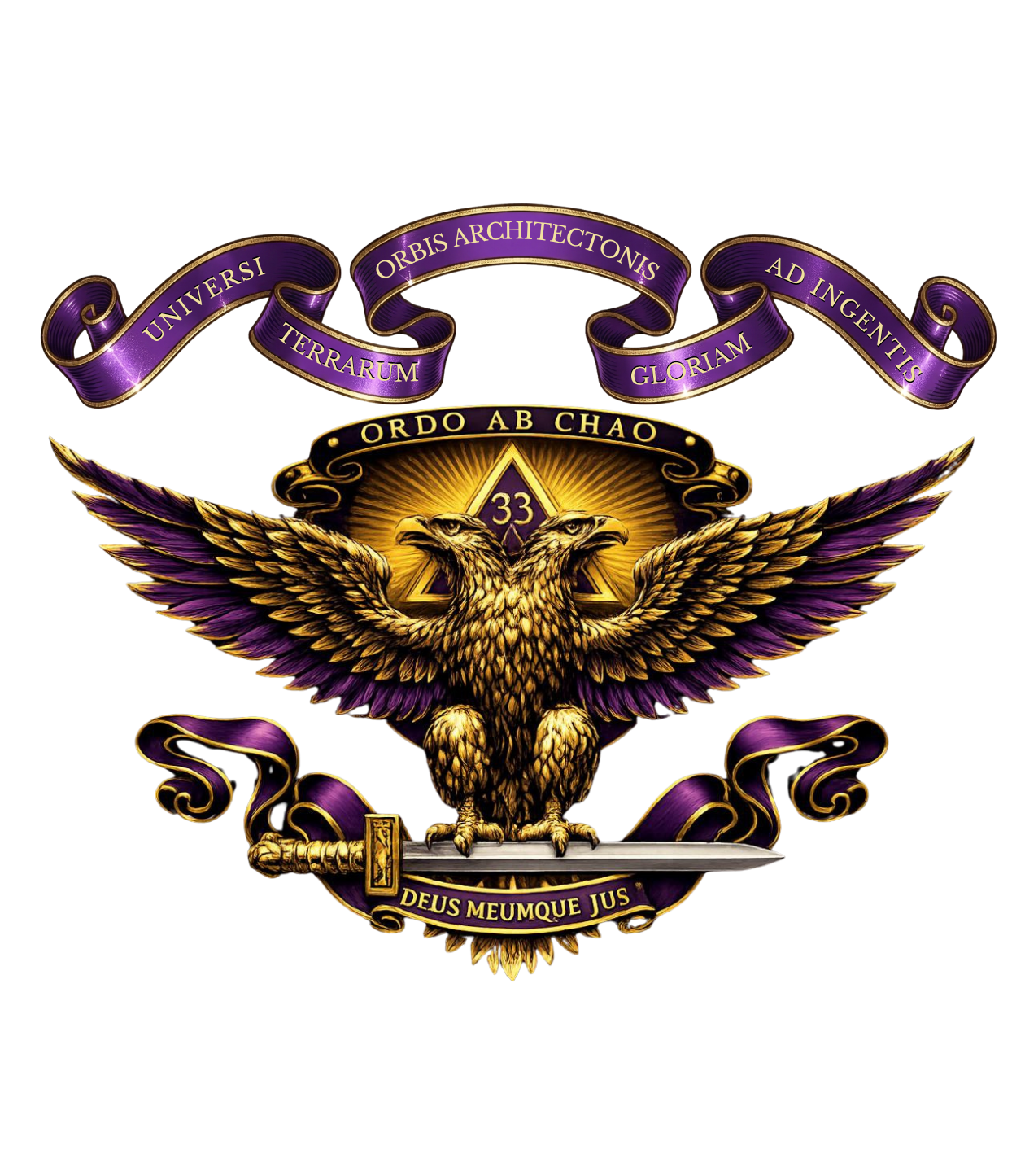
UNIVERSI TERRARUM ORBIS ARCHITECTONIS GLORIAM AD INGENTIS
Supreme Council Double Eagle
ORDO AB CHAO · SPES MEA IN DEO EST

Songs of the Rite

Now Playing: Albert Pike, Masonic Origins (1887), Pt. 1

Regularity and Constitutional Order

Regularity is understood as the convergence of lawful transmission, constitutional fidelity, sovereign jurisdiction, proper admission, documentary continuity, and faithful preservation of the Rite. The Supreme Council therefore maintains a traditional and disciplined practice rooted in the inherited doctrine and constitutional order of the high degrees.

The Rite is preserved through lawful Masonic authority, constitutional order, demonstrable continuity, and responsible governance within its proper sphere. Modern tools may assist the work, but they do not define the authority of the Rite.

Constitutional Governance and Modern Tools

Research may be assisted · Masonic authority remains constitutional

The Supreme Council recognizes that modern research tools may lawfully support archival organization, translation, indexing, drafting, education, correspondence, music, image preparation, and documentary comparison.

These tools are administrative and scholarly aids only. They do not initiate, recognize, ballot, discipline, govern, interpret the constitution, determine succession, or exercise Masonic authority.

The Rite is governed by duly constituted Masonic bodies and living Brethren lawfully vested with responsibility under constitutional order. This posture preserves the dignity of tradition while allowing careful use of modern instruments in subordinate service to the work.

Permitted Support Uses
Research, archives, drafting, correspondence support, education, translation, indexing, music, image preparation, and documentary preservation.
Reserved Masonic Powers
Initiation, recognition, ballot, constitutional interpretation, discipline, succession, sovereignty, and Masonic government remain within lawful Masonic authority.

Leadership and Officers

Public officer listing · concise institutional presentation

The Supreme Council publishes a concise officer listing for public transparency, orderly contact, and institutional identification. This public list identifies names, degrees, and offices only; internal records, votes, minutes, seals, signatures, and private administrative material remain within the custody of the Supreme Council.

Most Illustrious Brother A. L. Guerra, 33°
Most Puissant Sovereign Grand Commander
Most Illustrious Brother L. Le'Doux Jr., 33°
Assistant Most Puissant Sovereign Grand Commander
Honored Member of the Supreme Council Thirty-Third Degree
Most Illustrious Brother Bishop S. Ferguson, 33°
Assistant Most Puissant Sovereign Grand Commander ad Vitam
Very Illustrious Brother P. Nemanja, 33°
Puissant Lieutenant Grand Commander
Very Illustrious Brother D. Jackson, 33°
Assistant Puissant Lieutenant Grand Commander ad Vitam
Most Illustrious Brother L. Le'Doux Jr., 33°
Grand Orator and Minister of State
Very Illustrious Brother I, EL, 33°
Grand Secretary General H∴ E∴
Very Illustrious Brother G. Brown-Bey, 33°
Grand Treasurer General H∴ E∴
Very Illustrious Brother J. Crites, 33°
Grand Marshal General
Very Illustrious Brother T. EL, 33°
Grand Master General of Ceremonies
Most Illustrious Brother M. Quiroga Pérez, 33°
Grand Standard Bearer
Very Illustrious Brother K. El, 33°
Grand Seneschal
Most Illustrious Brother M. Quiroga Pérez, 33°
Grand Representive for Bolivia
Very Illustrious Brother D. Truax, 33°
Puissant Lieutenant Grand Commander ad Vitam
Most Illustrious Brother A. M. Guerra, PMPSGC, 33°
Entered into Eternal Light, 2021

This public listing is limited to institutional identification. It is not a publication of private membership records, deliberations, ritual proceedings, votes, or internal administrative instruments.

Protocols of Regularity

Continuity · sovereignty · constitutional order · lawful transmission
Historical Continuity
Regularity is inseparable from continuity of origin, lawful transmission, and documentary preservation through time.
Original Constitution
Regularity rests upon lawful constitution, proper historical context, and fidelity to the constitutional principles of the Rite.
Sovereign Jurisdiction
The Supreme Council is a sovereign Masonic authority within its own sphere and is not governed by symbolic administration.
Craft Foundation
No man may be advanced in the higher system unless he stands upon a lawful Craft foundation.
Individual Admission
Admission proceeds individually, by inquiry, examination, recommendation, and proper ballot.
Documentary Proof
Claims of continuity, constitution, and recognition must be capable of documentary verification through preserved records.

Authority and Jurisdiction

The authority of the Supreme Council is presented as a preserved and continuing expression of an historical current within the Scottish Rite, not as a novelty or casual invention.

It proceeds from the constitutional foundations of the Rite of Perfection, the later Thirty-Third Degree framework, and the Atlantic transmission of the Rite through European, Caribbean, and early American channels.

Jurisdictional Position

The jurisdiction exercised is internal and constitutional over its own system and members. It does not assert command over independent Masonic organizations, Grand Lodges, Grand Orients, Supreme Councils, or other jurisdictions.

This posture preserves dignity, avoids aggression, and maintains the sovereign integrity of the Supreme Council within its proper sphere.

Chronology of the High Degrees

A concise public sequence from Morin to modern custodianship
1744/1745 and 1761 — Morin Root and French Powers
The early high-degree foundation is associated with Étienne Morin and the French powers to propagate Perfect and Sublime Masonry in the New World.
1762 — Royal Secret and Rite of Perfection
The twenty-five-degree Royal Secret / Perfection framework supplies the older constitutional substrate from which later Scottish Rite developments emerged.
1762–1767 — Francken and the Caribbean Transmission
Henry Andrew Francken and the Caribbean/Jamaica stream preserve and transmit high-degree ritual and constitutional material.
1768–1781 — American Deputy Inspector Context
Moses Michael Hays and related American high-degree activity form part of the wider Morin-Francken transmission field.
1787–1791 — Saint-Domingue and Joseph Cerneau
Cerneau is connected with La Réunion Désirée at Port-au-Prince and the Saint-Domingue high-degree environment before the Cuba/New York transition.
1801 — Parallel American and Saint-Domingue Currents
American and Caribbean high-degree structures appear within the same broader French-Caribbean-Atlantic field.
1806–27/28 October 1807 — Cuba to New York
The Cerneau current passes through the Spanish Antilles/Cuba context into New York, where the New York establishment becomes the central ASRH 1807™ ancestral marker.
1813–1816 — Paris and New York Reception
The research position preserves the 1813 French confirmation-restoration claim and the 1816 acknowledgment/exchange context as major evidence markers.
1832–1836 — Western Hemisphere Continuation
The New York / Western Hemisphere treaty material is treated as later continuation evidence involving France, Brazil, Belgium, and New York.
1845–1884 — Atwood, Hays, Seymour, and Yarker
The Cerneau-line officer sequence and Seymour/Yarker date markers preserve the bridge into later European and British-linked transmission.
1905/1909–1927 — Scandinavian Line
The Scandinavian sequence is preserved through Brogren/Bogren, Sirén, and Edlund, with early twentieth-century Scandinavian institutional developments retained as supporting context.
19 April 2019–Present — ASRH 1807™ Custodianship
The modern custodianship of ASRH 1807™ and HEAO™ is presented as an institutional, archival, and constitutional preservation effort.

Petitions and Admission

Petitions for affiliation and advancement are received only by proper inquiry, character, lawful recommendation, and documentary standing.

A serious path within the Rite requires evidence of Craft foundation, disciplined intent, and respect for constitutional order.

Return to ASRH Home Visit Grand Orient